How to Create an SEO Content Strategy that Ranks

Table of Contents

Content is the soul of SEO, but not just any content: we are talking about content with intention, planning, and real purpose. That is, contained within a well-defined SEO content strategy.

For years we've heard the famous "content is king." And yes, it is. But even the best content gets lost in the Google abyss if it's not focused, optimized and strategically created for a specific audience.

So, how do you go from writing for the sake of writing to building a website that generates quality organic traffic and meets goals? The answer is here.

Welcome to this definitive guide to creating an SEO content strategy in 2025. If you're looking to position your website and not die trying, this post is for you.

What Is an SEO Content Strategy?

Clear definition with real examples

An SEO content strategy is the Detailed plan that defines what type of content you will create, for whom, with what intention, when and with what keywords, with the ultimate goal of position on Google and attract qualified traffic.

👉 It's not just about writing articles: it's about Align each text with a real search intent and with your business objectives..

Why is it so important for positioning on Google?

Because Google does not rank loose ideas or unfocused blogs.. Position concrete answers for real people. And for that you need:

  • Know what people are looking for.

  • Know how to search for it.

  • Know with what intention he is looking for it.

  • And you being there to respond with the perfect content.

Differences between writing content and creating SEO content

Write content
Create SEO content
Choose topics at random
To be based on a research keywords
Writing without a clear structure
Use a clear SEO architecture (H1, H2, H3…)
Not measuring results
Analyze CTR, traffic and conversions
Do not optimize titles, images or links
Apply On Page techniques from the beginning

Before Writing: Define the Intent, the Audience and the Objective

Before you start writing, you have to answer a fundamental question:

🧩 Who do I write for and why?

How to understand what the user is searching for (Search Intent)

There are 4 main types of search intent:

  1. Policy: “What is the Local SEO".

  2. Navigational"Zudro Digital Media Blog".

  3. transactional: “Hire writing SEO".

  4. Local News: “Content agency in Malaga.”

✅ Detecting this intention allows you align content with the user's exact needsAnd that, in Google's eyes, is worth gold.

Buyer personas: write for those who really matter

Knowing your audience is create for people, not robots. Define:

  • Age, interests and level of knowledge.

  • What you need and what you are looking for.

  • How he speaks, what terms he uses.

So can use the appropriate tone, examples, and keywords to truly connect.

SEO objectives vs. business objectives: Can they coexist?

Yes, and they should. An SEO post doesn't just seek traffic; it can also:

  • Generate leads.

  • Close sales.

  • Position the brand.

  • Build reader loyalty.

When you combine SEO and business strategy, content becomes an asset with real returns.

Step 1: Create a Realistic and Effective SEO Content Plan

Why do you need a content plan?

Without a plan, there is no direction. And without direction, all content is adrift. SEO content plan It's your compass to make sure that every post, every page, every word... has a purpose.

The goal here is not to publish for the sake of publishing. It's publish with strategy, intention, and consistencyAnd that can only be achieved with planning.

How to create an SEO-optimized editorial calendar

Un SEO editorial calendar It's not a pretty table in Notion. It's a growth tool.

Here are the key steps to create it:

  1. Define your publication frequency (realistic, please).

    • Once a week? Twice a month? It depends on your resources.

  2. Organize topics by clusters or key categories of your business

  3. Prioritize by SEO opportunity: Start with the most accessible keywords with clear intention.

  4. Includes review dates: Evergreen content needs love too.

👉 Use colors, labels, review dates, content objective, main keyword, intent… The more visual and detailed, the better.

Choosing the right topics and keywords: not just volume, not just intuition

One of the biggest mistakes when making an SEO content strategy is go for only the keywords with the most volume or simply “what I feel like writing.”

There are three factors to balance here:

Factor
Why does it matter?
Search volume
It assures you that there is real interest
Law
If it is too high, it will be difficult for you to position
User intent
The most important thing: do you want to read or do you want to buy?

Council Zudro Digital Media: starts with long tails (more specific) to position yourself sooner and build authority little by little.

Step 2: Do Strategic Keyword Research

If content is the body of SEO, Keyword research is its heartAnd no, it's not enough to choose keywords "just because" or because they sound familiar. This step goes far beyond finding "high-volume keywords." It's about understanding how your ideal client searches.

Informational, transactional, and long-tail keywords

👉 For content to rank and, above all, convert, you need to choose the right words according to your intention.

Here is a summary of the most important types of SEO keywords:

Keyword Type
Intention
Example
Policy
The user wants to learn
“what is digital marketing”
transactional
The user wants to buy
“best SEO agency in Granada”
Navigational
The user searches for a brand
“zara online”
Local News
Look for something nearby
“Cafeteria with Wi-Fi in Madrid”
long tail
Very specific
“WordPress template for dentists”

Avoid typical mistakes when choosing keywords

Here are the classic mistakes we see over and over again (and that keep you from SEO success):

  • ❌ Choose only keywords with high volume (without taking into account the competition).

  • ❌ Not analyzing the intention behind the search.

  • ❌ Not researching what content is already ranking and what you can contribute.

  • ❌ Ignore the trends or emerging keywords.

  • ❌ Choosing keywords that aren't aligned with your business (this happens more than you think!).

Expert Trick Zudro Digital MediaBefore deciding on a keyword, search for it on Google. Look at the results that come up. Are they informative? Product sheets? Lists? Comparisons? That's a KEY clue as to what Google expects you to offer for that search.

Step 3: Write SEO-Friendly Content That Adds Value

It's time to write. But not just any old way. Let's talk about how to write content. that Google likes... but above all that the user loves.

Because one thing is writing content and another, very different thing, is write SEO-friendly content. And even more: content SEO-friendly, useful and memorable.

What is SEO-friendly content and what isn't?

SEO-friendly content is content that:

Responds to a clear search intent.
It is structured for easy reading.
Include keywords and their variants naturally.
It provides real and original value.
It is visually and technically optimized.

On the contrary, a content not SEO friendly is one who:

❌ It focuses on repeating the keyword as if it were a magic spell.
❌ It doesn't bring anything new.
❌ It is poorly structured and has mile-long paragraphs.
❌ It doesn't connect with the reader (or doesn't even take them into account!).
❌ It has technical errors (slowness, no tags, no metadata…).

Remember: SEO friendly does not mean roboticThe balance lies in creating optimized content… without losing your voice, your style and your humanity.

How to structure a perfect SEO post

Here's the basic structure that works (and that we use at Zudro Digital Media for our own posts and clients):

  1. Attractive title with main keyword
    Example: “SEO Content Strategy: Step-by-Step Guide for Your Website.”

  2. Powerful and contextual introduction
    Engage. Explain what it's about and why it's important. Generate curiosity.

  3. Well-organized headings (H2, H3, etc.)
    Organize. Divide into chunks. Make scanning content easy.

  4. Short paragraphs, lists, bold
    Don't make the reader sweat. Make them want to keep reading!

  5. Quality internal and external links
    Improve your experience and boost your SEO.

  6. Optimized images
    They should add to the content, not be mere decoration. Always use ALT text.

  7. Conclusion with CTA (call to action)
    Now what? Invite the reader to do something: comment, download, read another post, etc.

Ideal length, scannability and human tone

🎯 ExtensionThere's no magic number. But there is a rule: Write what is necessary to solve the reader's problem, without filling in the blanks.
(Can a 700-word post rank? Yes. Will a better-made 2.500-word post outrank it? Yes.)

👀 Scannability: Use subtitles, bullets, emojis if the tone allows it, images and visual calls so that the reader Do not miss.
(Many will read diagonally: give them anchors to stay!).

🇧🇷 Human toneWrite as if you were telling someone face-to-face. Even in a technical post, you can be clear, relatable, and educational.

At Zudro Digital Media, we have a maxim: if the reader understands it, Google will too.

Improvable Title
SEO-friendly title
Digital Marketing for Beginners: A Step-by-Step Guide (2025)
All about SEO
What is SEO and How It Works to Position Your Website
How to earn money
How to Make Money Online: 10 Strategies That Work
Kitchen Recipes
10 Easy and Healthy Recipes to Cook at Home
My trip to Rome
Guide to Traveling to Rome in 2025: What to See, Eat, and Enjoy

Step 4: On-Page SEO Optimization of Content

You've already written your content, structured it, and thought it out for the user. But... now it's time to polish it like a jewel before launching it into the world.

Optimization On Page SEO It's like putting a good label on a bottle of wine: If you don't know what's in it, no one chooses it.

Let's break it down the key factors so that your content not only pleases the reader, but also enchants Google's algorithms (yes, they also have a heart... made of silicon).

Irresistible title and meta description

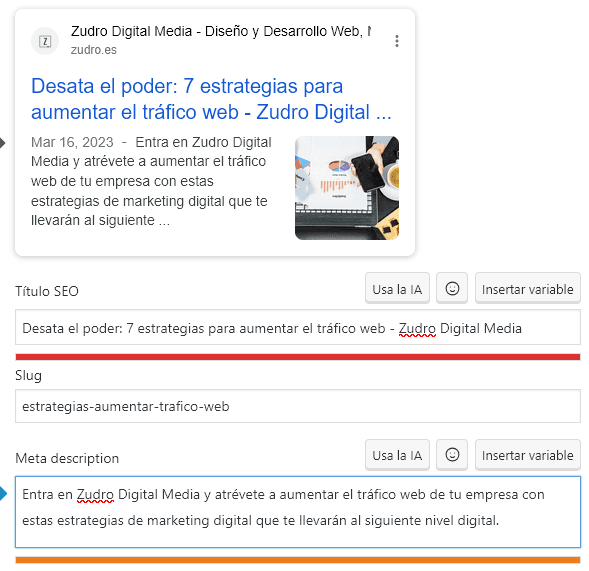
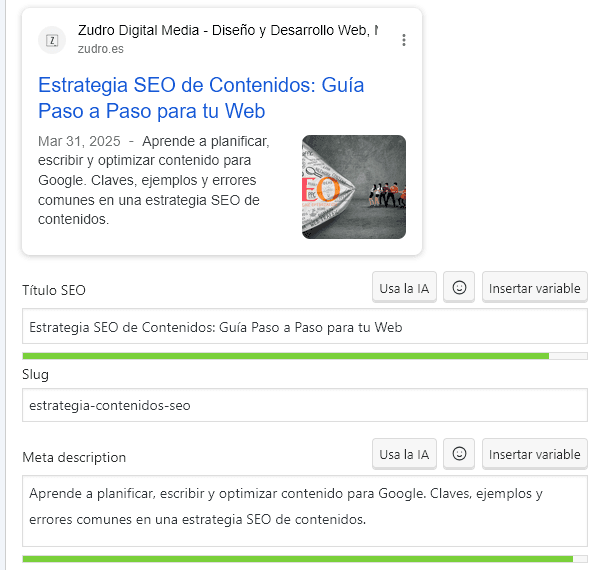
Tu title and your meta-description They're the first thing someone will see on Google. Are you going to miss out on that opportunity?

  • Title tag: It should contain the main keyword (best at the beginning), be between 45 and 60 characters long, and generate clicks.
    Good example: Estrategia de Contenidos SEO: Cómo Crear un Plan que Funcione

  • Meta descriptionThis is your chance to "sell" the content. Be clear, compelling, and add a small hook. Keep the text to 155 characters.

poor SEO optimization

Natural use of the main keyword and its variants

Use your main keyword with head and coherence. Don't repeat it over and over (that's a 2008 thing).

✅ Include it in:

  • Title

  • First paragraph

  • A subtitle (if appropriate)

  • Throughout the text in an organic way

  • In the ALT of an image (if relevant)

Furthermore, use synonyms and semantic variants (LSI). It's not all about repeating "SEO content"; you can also use "content strategy," "optimized content," "Google-friendly text," etc.

Optimizing images, internal links, and Core Web Vitals

Images aren't just for show. Well-optimized images help with SEO. Make sure you:

  • Use compressed formats (WebP if you can)

  • Add alt text descriptive (yes, with keywords if they are relevant)

  • Name the files well (nothing like that) IMG00234.jpg)

🔗 Internal links: Connect that content to other relevant posts or pages on your website. This way, you build SEO architecture and retain users.

Are you interested in reading:  Google Business Profile: What It Is, Advantages, and How to Create Your Profile

Core Web VitalsDon't forget. Even if it's not 100% text, speed, stability, and loading experience also count as on-page SEO.

Mobile First: Optimize for mobile first

Google no longer thinks about computers... it thinks about fingers sliding on mobile phones. So:

  • Use legible fonts

  • Large and accessible buttons

  • Short paragraphs

  • Content that does not require zoom

On-Page SEO ≠ keywords only

Yes, the keyword matters. But Real On-Page SEO is a mix of clarity, context, quality and experience.

Your goal isn't to "use the keyword many times," but rather to make sure Google understands clearly:

  • What topic does your content cover?

  • What intention does it respond to?

  • Whether or not it deserves to be in the first results

Step 5: Spread the Word, Promote, and Linkbuild

Creating SEO content and not moving it is like opening a store in the desert and waiting for customers. If you want that content to generate traffic, links, and visibility, you have to get it in front of the right people.

Here are the channels, strategies, and tricks to keep your post from becoming invisible. 👇

SEO content doesn't live alone: how to give it visibility

It's not enough for Google to find it. Sometimes, visitors come from other places before the search engine:

  • Social networks (LinkedIn, Instagram, Twitter/X, Facebook)

  • Newsletters

  • Slack and private groups

  • Niche communities (Reddit, Quora, specific forums)

  • Even WhatsApp or Telegram if your community uses it!

💡 Royal CouncilTailor your message to each channel. What you post on LinkedIn isn't the same as what you post on Instagram. Always create a hook to get them to click.

Social media, email marketing, and strategic collaborations

Email marketing remains one of the best allies of SEO content.
Create a segmented list and send useful content (not just promotions).

✅ Do you have allies, partners, or people in the sector with a good audience?
Create collaborations or natural visibility exchanges. The typical:

“Hey, I just posted something that I think might be a good fit for your community, check it out.”

But don't spam! Be human and genuine. 🙏

Links That Add Up: How to Attract Backlinks to Your Content

Enter the linkbuilding, that magic word that scares (and enamors) SEOs so much. But you don't have to get involved in shady paid link networks. You can get backlinks naturally and strategically:

  1. Make content worth linking to: studies, tutorials, guides like this one, free tools, downloadable checklists…

  2. Share on websites where there are creators or media: Journalists, bloggers and creators live on Twitter/X, newsletters and platforms like Reportaro (Spain) or Qwoted (USA).

  3. ask for feedback Before links: "What do you think of this article? Is it useful?" is much better than "Can I have a link?" If you like it, the link will come automatically.

  4. Update and improve old content with new references and external citations. Then write to the original authors. This is value networking.

Step 6: Measure, Adjust, and Re-Optimize

This isn't just posting and crossing your fingers. good SEO content strategy You need to have a constant review system. Otherwise, you'll be wasting time (and likely money) without knowing if you're on the right track.

What metrics really matter in SEO content?

Forget about likes for a moment. If you want to know if your content is working, These are the metrics that really matter:

  • Impressions: how many times it appears in search results.

  • Clicks: How many times someone clicked on your content from Google.

  • CTR (Click Through Rate): percentage of clicks compared to impressions.

  • Middle position: where it appears in the ranking.

  • Positioned keywords: what terms your content has captured.

  • time on page:Do people stay reading?

  • Bounce rate: Do they run away when they arrive?

  • Conversion: : Was the content objective (form, sale, subscription, etc.) met?

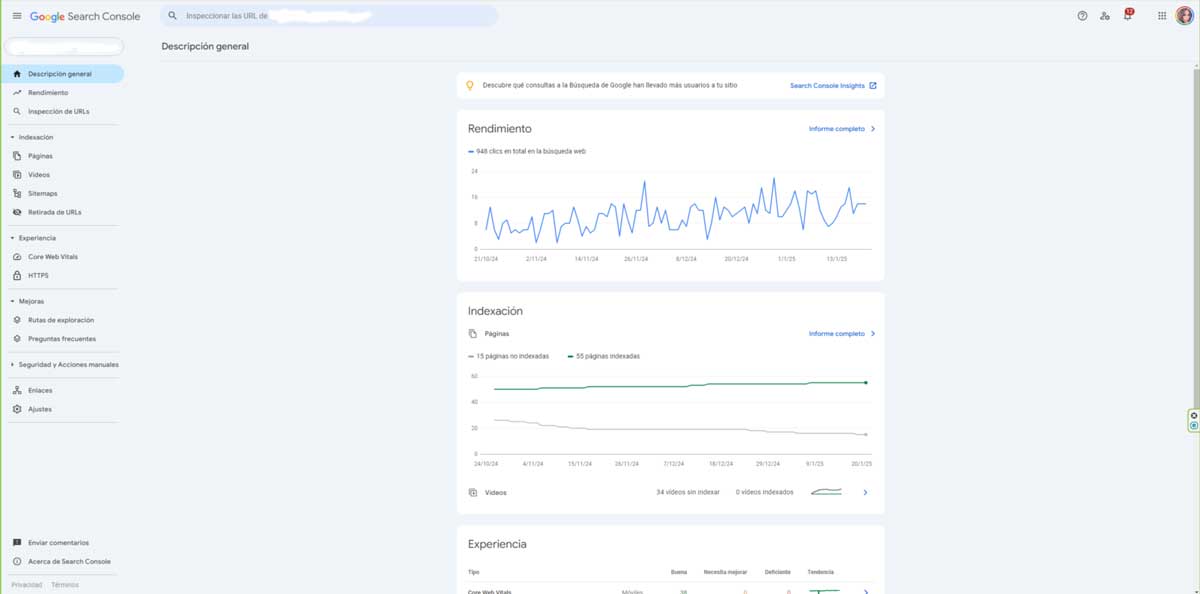
💡 Pro tip: uses Google Search Console, Google Analytics 4 and tools like Ahrefs or Semrush to cross-reference data and see the evolution.

How to spot opportunities for improvement after publishing

Content not ranking higher?
Is the CTR below 2%?
Are you not capturing the keywords you expected?

Don't throw the post away. Review it and make small adjustments:

  • Improve the title and meta to make them more attractive.

  • Add new and deeper content.

  • Strengthen internal linking from other URLs on your site.

  • Optimize better for search intent (maybe you're not solving what the user wants?).

  • Improve loading speed, mobile experience or WPO.

Content Update: When and How to Do It Right

In SEO, what ranks today may fall tomorrow. But here's one wonderful thing: the content can be updated.

📌 When is a good time to update?

  • When the keyword starts to drop in positions.

  • When there is new relevant information that you can add.

  • When CTR drops for no apparent reason.

  • When the content no longer meets the current search intent.

💡 Professional advice: Each quarter, review your key items. Create a table with these fields:

  • URL

  • Main keyword

  • Actual position

  • CTR

  • Last updated

And with that table, decide which ones deserve immediate review.

Common Mistakes in SEO Content Strategies

Even if you're clear about your intentions, have done decent keyword research, and are careful with your writing... it's easy to slip up. SEO is unforgiving of the absent-minded, but it does reward those who learn. So take note.

❌ Writing without a plan or research

Posting for the sake of posting is like talking without knowing if anyone is listening.

Many people jump into creating content thinking, "This is bound to be interesting." But without an editorial plan, without keyword research or prior analysis, that content will most likely get lost in the depths of Google (second page or beyond…).

Are you interested in reading:  Should you post weekly or only when you have something powerful? We'll explain.

A satisfactory solution:
Always create your content with a strategy behind it. Each post should have a clear intention, respond to a real need and to be aligned with your positioning.

❌ Duplicate or “SEO-stuffed” content

The famous "SEO stuff" is that content that seems like it says a lot... but says nothing. Empty phrases, unnecessary repetition, paragraphs with no added value just to add words.

Duplicate content is just as serious: copying and pasting, even from your own site, can hurt your rankings.

A satisfactory solution:
Get to the point. Dig deeper. Contribute. Each line must have a purposeAnd if you're going to talk about something that already exists, improve on what's there. Don't copy it.

❌ Ignoring the user's real search intent

This is probably the most common mistake and the one that most affects positioning.

Imagine someone is searching for:
“best coffee maker for small office”.

And you write a general guide on "how a coffee maker works." You're not addressing the intent of that search. Google knows it, the user knows it too… and the bounce is guaranteed.

A satisfactory solution:
Before writing, search for that keyword yourself on GoogleAnalyze what type of content is ranking: Are they lists? Guides? Comparisons? Videos?

And then, create something that answers BEST that everything is already there.

❌ Do not update the content or review its evolution

Publishing content and forgetting about it is another big mistake. Even if it works at the time, SEO is not staticIf you don't review your content regularly, it will eventually lose its impact.

A satisfactory solution:
Create a quarterly review routine. Evaluate CTR, position, intent, competition… and Update your content to keep it fresh and competitive.

FAQ


There's no magic number. But there is a key: Consistency and quality win over aimless volume.

If you are just starting out, with 2 or 4 well-optimized and strategically thought-out articles per monthYou can achieve very good results in just a few months. If you already have authority, you can increase the frequency, but always make sure that each piece of content contributes.

My adviceDon't just post for the sake of posting. Create content that's worth ranking for.

It depends (yes, the typical SEO answer... but it's true).

In low-competition sectors, you can see improvements in a matter of days or weeksIn more competitive markets, it can take Several months see solid results. And if you're starting from a new or low-authority website, patience is key.

👉 The important thing: Do good keyword research, create excellent content, optimize it on-page, and work on it over time..


Very much.
Updating your content can give them a new life on Google, especially if they already had some traffic and have dropped in positions.

✔️ Add new information.
✔️ Improves readability.
✔️ Optimize titles, internal links, and calls to action.
✔️ Update the dates if it is evergreen or annual content.

Sometimes, A 20-minute update is more effective than creating a new post from scratch..


Not necessarily. Although tools like Semrush, Ahrefs, or SE Ranking make the journey much easier, You can start with free resources like:

  • Google Search Console

  • Google Trends

  • Keyword Planner

  • AnswerThePublic

  • AlsoAsked

  • Ubersuggest (free version)

📌 Of course: when you scale and have a budget, Investing in tools will be a wise decisionYou'll save time, improve accuracy, and be able to make better strategic decisions.


Don't panic. Check:

  1. Have you chosen the right keyword?

  2. Does your content really address search intent?

  3. Is it well structured and optimized?

  4. Do you have well-developed internal and external links?

  5. Have you promoted it?

Sometimes you just need give it more time, more love, or a little strategic push.

Conclusion

If you've made it this far, you already know that an SEO content strategy isn't about writing for the sake of writing. Nor is it about stuffing your website with random keywords or trying to "please Google" with tricks.

An well-planned content strategy It looks more like this:

✅ Know who you are writing for.
✅ Understand what that person is looking for and how they are looking for it.
✅ Plan useful, relevant, and sustainable content.
✅ Optimize without obsessing.
✅ Measure, adjust, and republish.

Because yes, he SEO content It is one of the most powerful tools you can use to grow organically, sustainably, and in alignment with your business objectives.

Your next step: get your hands on the keyboard

You don't need 50 posts ready or even programming skills to get started. You just need clarity, method, and consistency.

And to help you, here I leave you:

📅 Editable template for create your own content plan and schedule posts.
🔗 Access to future guides from Zudro Digital Media, where we continue to break down SEO with style, real-life examples, and no empty jargon.

Are you creating SEO content with intention or are you just winging it?
Tell me in the comments or write to me and we'll review it together. And if you want your website to stop being invisible... 👇
Request your personalized SEO audit.
(I promise you'll see your content in a different light after that.)

See you in the next post from Zudro Digital Media.
Until then: create, connect, and optimize ✨

Table of Contents

Share me on your social media
Best Hosting in Spain
LucusHost, the best hosting
Best VPS in Spain
Raiola Networks
Share me on your social media

Related Entries

update SEO content

Do You Have Keyword Cannibalization on Your Website? Learn How to Detect It

meta tags

What are Meta Tags?

seo content

How to Create an SEO Content Strategy that Ranks

adapt the web to voice search

How to adapt your website to voice search (and if it's worth it)

PBN

What is a PBN and How Does it Work? Advantages, Risks, and Best Practices

complex web redesigns without losing traffic or SEO

How to manage complex redesigns without losing data or SEO

update SEO content

Ideal Frequency to Update Your Content

screenshot google search console

Google Search Console: What It Is, How to Use It, and Its Benefits

Accessibility options

Quick Presets
font Size
Line Height
Letter spacing
color Schemes
text alignment
Options
Reading & Focus
Read Aloud Method
Speed: 1x
Cursor Size