There is one phrase that can turn a perfectly normal business conversation into an awkward moment: "And how much does it cost?"
Up until that point, everything was going smoothly. You'd listened to the client, understood their needs, explained how you could help, and they even seemed enthusiastic about your proposal. But then the price question came up, and suddenly you started offering explanations no one had asked for. That it takes many hours, that you use good tools, that you usually charge more… And, of course, the classic “although we can adjust it” appeared.
Does this sound familiar? You're not alone. Talking about money remains one of the most delicate moments in any business relationship, especially when selling services , expertise, or creative work.
However, learning how to communicate prices to clients isn't about developing an aggressive salesperson's personality or convincing everyone that our rates are fantastic. It's about presenting a proposal clearly, conveying its value, and allowing the other person to make an informed decision.
Because there is a huge difference between explaining a price and apologizing for it.
In this guide, we'll explore how to discuss pricing with clients comfortably, how to present quotes, address objections, and communicate price increases without damaging the business relationship. We'll provide examples you can use tomorrow, without resorting to the typical "if you believe in yourself, the client will too" approach.
I wish it were that simple.
Why do we find it so difficult to talk about prices with customers?
Money has a peculiarity: we all know that products and services cost money, but when it comes to saying how much we charge, we sometimes act as if we are delivering bad news.
This is especially true in businesses where the service depends directly on a person's work. A designer, a consultant, a photographer, or a web developer doesn't just sell a tangible product. They sell knowledge, experience, dedication, and problem-solving skills.
And when the client questions the price, it's easy to interpret it as a criticism of one's own work.
But someone finding a proposal expensive doesn't necessarily mean they're questioning your professionalism. Perhaps they have a smaller budget, are comparing different services, or simply don't yet understand what the offer includes.
The problem arises when we respond to that uncertainty by lowering our standards before knowing the true objection.
Imagine a professional submits a quote of 900 euros and receives the response: "Ugh, I thought it would be much less." If they immediately reply, "Well, I could do it for 700," they've just reduced the price by 22% without knowing if the 900 euros was actually a barrier to hiring.
Furthermore, it has raised an unnecessary question: if he could offer exactly the same thing for 700 euros, why did he ask for 900 at the beginning?
Confidence in communicating prices isn't achieved by adopting an inflexible attitude. It's built by clearly understanding what you're selling, how much work is involved, what costs you need to cover, and under what conditions you can modify a proposal.
Before learning how to quote a price to a client, you need to have a consistent and sustainable pricing structure. If you can't explain how you arrived at that price, it will be more difficult to defend it naturally.
That doesn't mean you have to tell every client your internal costs or justify every euro. It means you should know them.
How to communicate your prices confidently and naturally
There's no magic phrase that will get any customer to accept a price. What we can do is avoid communication mistakes that breed distrust, hinder comparisons, and make price the sole focus of the conversation.
The key is to find the balance: neither hiding the cost until the last moment nor revealing a figure without explaining what the customer receives in return.
Present the value of your service before stating how much it costs.
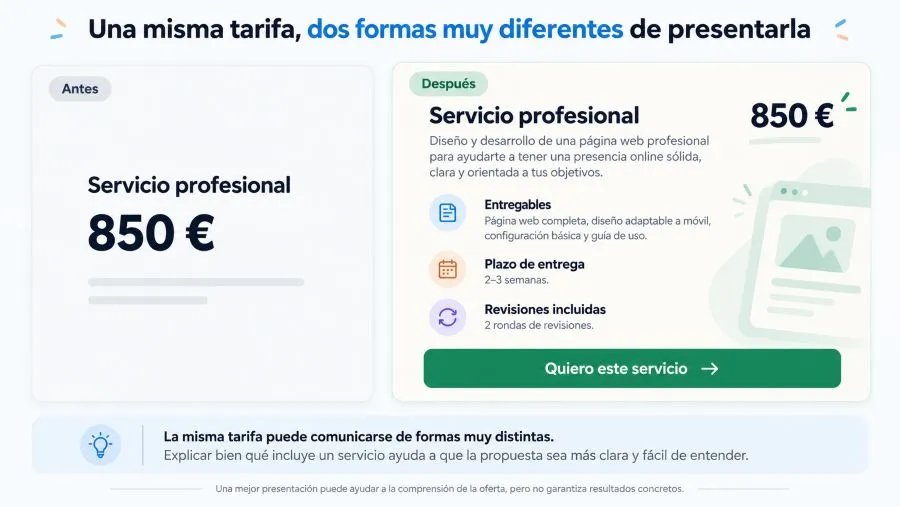
Consider these two ways to present a web design service:
"A website costs 1.200 euros."
"For 1.200 euros you will get a corporate website with five pages, mobile-friendly, with a contact form, basic SEO setup and training so you can update the content."
The price is identical, but the information available to value it changes considerably.
In the first case, the customer can only compare a number. In the second, they have a better understanding of what they are signing up for.
This doesn't mean you should promise results you can't guarantee. A website designed to facilitate lead generation doesn't guarantee you'll acquire a specific number of clients.
The important thing is to connect the service's features with real needs.
If someone wants a website because they constantly receive the same questions by phone, you can explain how to organize services, FAQs, and forms to facilitate those inquiries. If they need to improve their digital presence, it will make more sense to talk about structure, user experience, and visibility.
The value lies not in reciting everything you know how to do, but in explaining why certain features are useful to that client.
And when you don't yet know their needs, it's best to ask a few questions before preparing a detailed proposal.
Explain what the price includes and avoid surprises
Few things damage a business relationship as much as discovering unexpected costs when the work is already well underway.
A budget can be perfectly reasonable and still generate distrust if it does not make clear what is included.
In a web project, for example, it is advisable to specify whether the price includes the texts, the domain, the hosting, the content upload, the subsequent maintenance or certain integrations.
You don't need to turn your proposal into a forty-page contract, but you do need to define its scope.
A real-world example of how to present this information can be found in Zudro's WordPress web design service , where they differentiate what's included in the advertised package from certain elements that are quoted separately. This separation helps the client understand what they're getting before signing a contract.
Furthermore, if you work with consumers, you must comply with the applicable pre-contractual information obligations and the presentation of the total price, including applicable taxes and expenses.
Commercial clarity is not just a matter of style: it also prevents future conflicts.
State the price clearly, without apologizing or over-justifying.
Once the service has been explained, it's time to state the price. And our advice here is quite simple: just say so.
You don't need to precede it with five warnings or accompany it with a nervous explanation about how much you work.
Phrases like "I know it's a bit expensive," "I usually charge this, but…" or "I hope you don't think it's too much" condition the perception of the offer before the customer can evaluate it.
Specific communication is preferable:
"The budget for the described project is 1.200 euros plus VAT, with an estimated timeframe of four weeks and two rounds of revisions included."
Then, allow the customer to respond.
You don't have to fill every silence with new arguments. And certainly, you shouldn't offer a discount simply because the other person takes a few seconds to reply.
Avoid saying | Test |
|---|---|
"I know it's expensive, but..." | "The price of the service is €850 and includes…" |
"I can lower the price if you want." | "We can adjust the scope to suit your budget." |
"It takes me many hours." | "The work includes these phases and deliverables" |
"It will cost you roughly..." | "With the current information, the estimated range is..." |
"I'm sorry, I've had to raise prices." | "The new rates will apply from this date." |
Adapt the way you communicate it to the type of customer
It is not the same to present a budget to someone looking for an economical and standardized solution as it is to a company that needs a complex and customized project.
In the first case, it probably makes sense to show fixed prices, features, and easily comparable conditions. In the second, it will be necessary to understand the scope before setting a final price.
For example, a company that hires web maintenance services might appreciate being presented with three plans with clear monthly prices. On the other hand, a business that needs to develop a platform with specific functionalities will require a proposal tailored to its requirements.
At Zudro, both models coexist: a digital services store with fixed prices and projects that require individual assessment. These models are not incompatible; each corresponds to a different form of contracting.
We also need to consider how much the client knows about the service. Someone who has never used SEO services will likely need more context than a marketing professional accustomed to working with agencies.
Adapting the explanation does not mean arbitrarily changing the price depending on who asks, but presenting the information that each interlocutor needs to understand the offer.
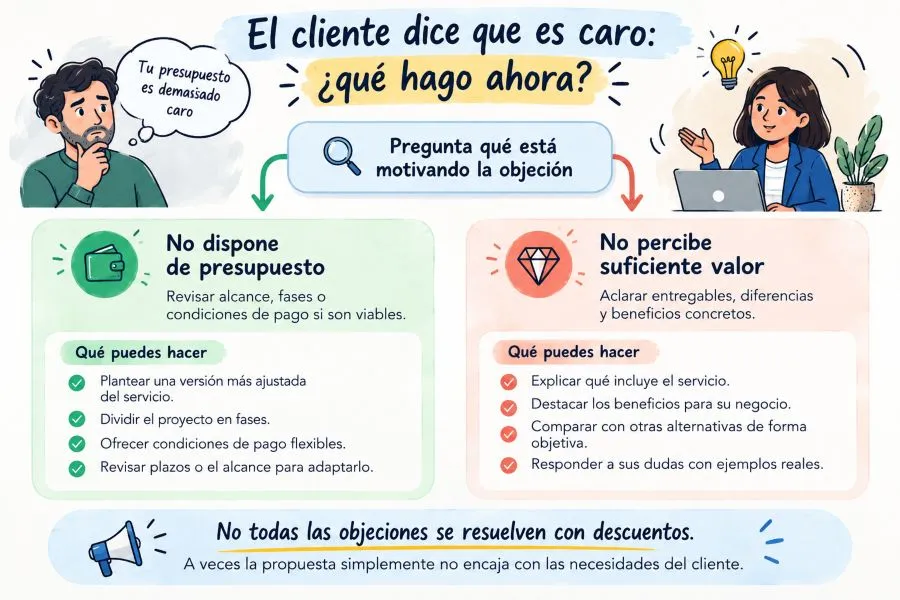
What to say when a customer tells you "it's too expensive"
This objection usually generates an almost automatic reaction: defending the budget.
But before we do that, we should find out exactly what "expensive" means.
It could mean that the customer does not have enough budget, has found a cheaper alternative, or does not perceive a significant difference between the two offers.
It can also be a way of expressing that he is not yet convinced.
Therefore, instead of preparing an endless sales pitch, it is more useful to discover what is behind the objection.
How to respond without immediately lowering the price
A simple answer can open up a much more productive conversation:
"I understand. Does it deviate from your planned budget, or is there some aspect of the service whose value isn't entirely clear to you?"
The question allows us to differentiate between two problems that require different solutions.
If the client has €600 and your proposal costs €1.200, you likely have a genuine budget constraint. If they have the money but don't understand why your service costs more than another, there may be a problem with comparison or communication.
In that second scenario, it's worth explaining the specific differences between the proposals, if you're aware of them. Perhaps one includes maintenance and the other doesn't, or one involves customized work while the alternative uses a standardized solution.
What you shouldn't do is discredit a competitor without knowing their work.
When to negotiate and when to stick to your rates
Negotiating doesn't have to be negative. The important thing is to distinguish between lowering the price without reason and modifying the terms of a proposal.
If a client needs a five-page website but cannot afford it, it might be possible to start with a smaller phase and expand the project later.
However, a lower price should imply a different scope or some condition that justifies the adjustment. Maintaining the exact same deliverables, deadlines, and responsibilities while charging considerably less can compromise profitability.
There are also situations where the wisest thing to do is not to accept the job.
If a proposal is below your costs, requires impossible deadlines, or depends on promises you can't guarantee, closing the sale won't necessarily be good news.
Learning how to sell without lowering prices also involves recognizing when a transaction is not advisable.
Not every client has to hire you. And not every rejected quote represents a missed opportunity you should try to recover at any cost.
Practical examples for communicating prices without discomfort
Theory is all well and good, but this topic is much better understood through concrete conversations. Let's look at three common situations in service companies, with examples of how to present prices without sounding aggressive, insecure, or overly salesy.
How to quote the price of a service for the first time
Imagine a small business needs to renew its website and asks you directly how much it costs.
A less helpful answer would be: "It depends, there are many possibilities and I would have to study everything."
It's true that it depends. But it's also true that you can offer guidance.
A clearer alternative would be:
"For a corporate website like the one you describe, we usually work with a budget that depends on the number of pages and the functionalities. I can give you a guideline range and, when we review the details, prepare a final proposal with everything included."
If you have a specific price for a standardized package, you can also present it directly. The goal is to prevent the client from having to go through several meetings just to find out if the service is within their budget.
Transparent communication allows for filtering expectations and saves time for both parties.
How to send a quote without it all revolving around the price
A quote should not look like an invoice sent before the work is done.
The client needs to know how much they will pay, of course, but also what problem is intended to be solved, what they will receive, what the deadlines are, and what the contract will have conditions.
A simple structure may be sufficient:
Brief summary of the identified need.
Description of the service and deliverables.
Deadlines, reviews and responsibilities.
Price, taxes and payment terms.
Exclusions and acceptance procedure.
For example, instead of simply sending "Web design: €1.200", you can explain that the quote includes a five-page corporate website, mobile responsiveness, basic form setup, and a training session.
If new features appear later, it will become clearer what an expansion of scope entails.
This way of presenting budgets does not guarantee that the client will accept the offer, but it makes it easier for them to evaluate it correctly.
How to communicate a price increase to current customers
Raising prices can be even more awkward than introducing them for the first time, because a business relationship already exists and the customer has a reference point for what they were paying.
But maintaining the same rates indefinitely isn't always viable either. Costs increase, services evolve, and the level of dedication required to provide them can change.
The key is to communicate the change well in advance, indicate when it will be applied, and explain how it affects the customer.
For example:
"We would like to inform you that, starting January 1st, the monthly service fee will increase from 90 to 105 euros. This change will take effect at your next renewal, and we will maintain the agreed-upon benefits. If you would like to review the terms or consider another plan, we can discuss it before that date."
There's no need to turn your communication into a five-paragraph apology. Nor is it advisable to present a price increase as a major improvement if no new features are actually being added.
And there's a crucial point: before changing rates in existing contracts, you must review the agreed-upon terms and applicable legal requirements. Not all business relationships allow for unilateral changes.
Mistakes that make your prices seem less valuable
Sometimes the problem isn't how much we charge, but how we present the offer. A reasonable rate can seem unattractive when the communication is confusing, overly defensive, or leaves too many questions unanswered.
These are some particularly common mistakes:
Error | Why it harms | What to do |
|---|---|---|
Apologize for the price | It raises doubts about the proposal. | Communicate it naturally |
Giving a figure without explaining the service | It makes it difficult to understand what is being contracted. | Detail deliverables and scope |
Offer discounts too soon | It can undermine the credibility of the rate | Ask about the objection beforehand |
Promising impossible results | It creates unrealistic expectations | Explain verifiable commitments |
Hide additional costs | It provokes surprises and conflicts | Clarify conditions and exclusions |
Using too much technical jargon | It makes it difficult to appreciate the usefulness of the work. | Talking about needs and solutions |

Something similar happens on websites. Displaying prices on a website can facilitate comparison and convey transparency, but only when the information is well presented.
A table containing three price lists without explaining their differences forces the visitor to guess which one they need. In contrast, a clear comparison of features, limits, and conditions makes the choice easier.
We should also avoid hiding essential information behind unnecessary forms. If you sell a service with a standardized price, it probably doesn't make sense to require names, phone numbers, and email addresses simply to reveal the cost.
This doesn't mean all companies should publish fixed prices. Custom projects may require a preliminary estimate. The key is to explain why and, where feasible, offer guidance to help visitors decide whether to request a quote.
From Zudro Digital Media , this approach connects directly with the design of web pages oriented towards the user experience : the way an offer is organized and presented influences how the potential customer understands it.
FAQ
It depends on the type of service and the information the client needs to assess it. If you're selling a standardized product or service, it usually makes sense to communicate the price upfront. For custom work, it may be necessary to define the scope beforehand, but it's advisable to offer some guidance whenever possible.
The important thing is not to deliberately hide the amount in an attempt to convince the customer before revealing it.
There's no one-size-fits-all answer for every business. If your services have defined features and prices, displaying them can make the buying decision easier. If you work on custom projects, you can present indicative price ranges, sample quotes, or explain what factors determine the cost.
In any case, you must comply with the legal obligations regarding price information that correspond to your activity and the type of customer.
Before accepting, try to understand why they're requesting it. If there's a genuine budget constraint, you can explore alternatives with fewer features, different payment plans, or other payment terms, provided it's feasible for you.
You are not obligated to lower the price simply because someone asks you to. A reasonable negotiation should work for both parties.
Conclusion
Learning to communicate prices to clients doesn't mean finding a formula to ensure no one ever questions your rates again. That would be great, but quite unrealistic.
It means being able to explain what you offer, how much it costs, and under what conditions without turning every business conversation into a personal defense of your work.
Some clients will accept your proposal, others will need clarification, and some simply won't fit your budget. All three situations are part of any business activity.
What you can control is the clarity with which you present your services, the consistency of your conditions, and the professionalism with which you respond to objections.
And that communication shouldn't be limited to meetings or quotes sent by email. Your website also plays a part in the sales process: it showcases your services, anticipates questions, and helps visitors understand why they should hire you.
At Zudro Digital Media, we focus precisely on that connection between communication, design, and digital strategy. Because an offer can be excellent, but if the client doesn't understand what they're signing up for, they'll hardly be able to appreciate its value.
You don't need to make your prices seem cheap to everyone. You need to make sure the right people understand what they're paying for.